Computational thinking skills are increasingly recognized as essential in today’s educational landscape. As technology continues to permeate various aspects of life, these skills empower students to approach complex problems systematically and creatively. By fostering logical reasoning and problem-solving abilities, computational thinking serves not only in computer science but also across diverse disciplines, enriching the overall learning experience.
Incorporating computational thinking into the curriculum is vital, as it bridges the gap between theoretical knowledge and practical application. This approach enables students to analyze real-world problems, encouraging them to think critically and develop innovative solutions. Through practical examples, we can see how these skills enhance the understanding of social phenomena and empirical data, preparing students for future challenges.
Importance of Computational Thinking Skills
In today’s fast-paced digital world, computational thinking skills have become crucial for students to thrive academically and professionally. These skills enable learners to approach complex problems methodically, fostering a deeper understanding of various subjects while preparing them for the challenges of the future. Emphasizing computational thinking in education equips students with the tools they need to navigate a technology-driven landscape and enhances their overall learning experience.Computational thinking is not limited to computer science; its principles can be applied across numerous disciplines to enhance problem-solving abilities.
For instance, in mathematics, students can break down challenging problems into smaller, more manageable components, utilizing algorithms to find solutions. In the sciences, students can employ computational models to simulate experiments, analyze data, and draw meaningful conclusions. By integrating computational thinking into various subjects, educators can cultivate critical thinking and innovative approaches among students.
Enhancement of Problem-Solving Abilities
Computational thinking fosters a structured approach to problem-solving that is applicable in many fields. Understanding this process encourages students to think logically and creatively. The following points illustrate how computational thinking enhances problem-solving across disciplines:
- Mathematics: Students learn to decompose complex equations into simpler parts, making it easier to find solutions and understand concepts such as fractions or algebraic expressions.
- Science: Learners can construct algorithms to predict outcomes of scientific experiments, allowing them to analyze trends and test hypotheses effectively.
- Social Studies: Computational thinking helps students analyze data trends, such as population growth, using statistical methods to interpret historical events and societal changes.
- Language Arts: Students utilize computational skills to organize information and develop Artikels for essays, enhancing their writing structure and clarity.
In everyday life, the relationship between computational thinking and logical reasoning plays a significant role in decision-making. Individuals apply computational methods to evaluate options, assess risks, and determine the best course of action. For example, when planning a budget, one must consider various factors, such as income, expenses, and savings goals. By breaking down these elements, individuals can make informed financial decisions that align with their objectives.
In essence, computational thinking enhances our ability to reason logically and solve problems effectively, both in academic settings and daily life.
“Computational thinking empowers individuals to approach problems systematically, fostering innovative solutions across various fields.”
Applications in Social and Empirical Sciences
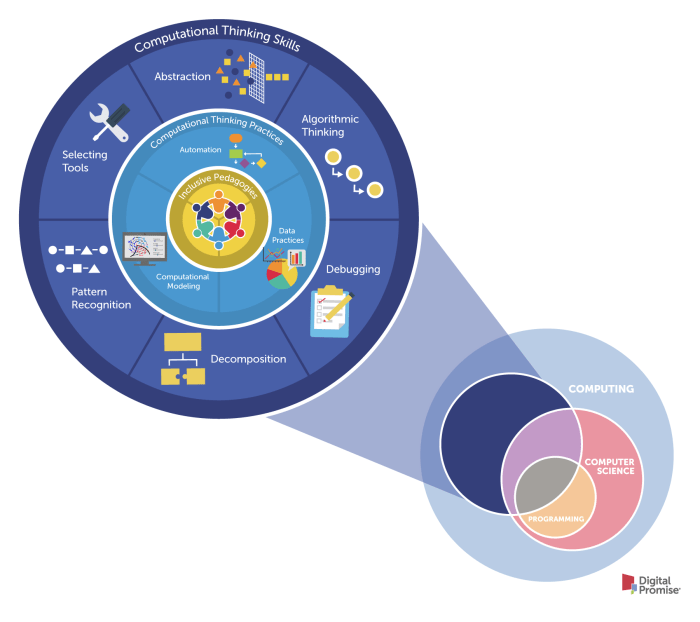
Computational thinking skills have become increasingly vital in the realm of social and empirical sciences. These skills enable researchers to dissect complex social phenomena and analyze empirical data with a structured, algorithmic mindset. By applying computational thinking, scholars and practitioners can enhance their ability to interpret and understand intricate social systems, leading to more informed decision-making and policy formulation.The integration of computational thinking into social science research and statistics can provide a comprehensive framework for exploring diverse datasets and uncovering patterns.
This method emphasizes abstraction, decomposition, pattern recognition, and algorithmic thinking, which are essential for analyzing social dynamics and behaviors. Researchers can utilize computational models, simulations, and data analytics to gain insights that traditional methods may overlook.
Integration of Computational Thinking in Research
Integrating computational thinking into social science research involves several methodologies and practices. By employing these techniques, researchers can enhance their analytical capabilities and improve the accuracy of their findings. Here are some methods for effective integration:
- Data Mining and Analysis: Utilizing advanced data mining techniques allows researchers to extract valuable insights from large datasets, identifying trends and correlations that inform social theories.
- Simulation Models: Building computational models that simulate social phenomena can help researchers visualize complex relationships and test hypotheses in a controlled environment.
- Machine Learning: Applying machine learning algorithms enables researchers to analyze vast amounts of data, improving predictive accuracy and revealing hidden patterns in social behavior.
- Network Analysis: By employing network analysis techniques, researchers can study the interconnectedness of social entities and understand how relationships influence social outcomes.
“Computational thinking transforms the way social scientists approach data, allowing for richer insights and more robust conclusions.”
Case Studies in Data Interpretation
Numerous case studies illustrate the successful application of computational thinking in interpreting data within social sciences. These examples highlight the effectiveness of computational approaches in revealing significant findings that conventional methods might miss.
- Predictive Policing: In cities like Los Angeles, predictive policing algorithms analyze crime data to forecast potential criminal activity areas. This approach has led to more efficient resource allocation and crime prevention strategies.
- Social Media Analysis: Researchers at various universities have employed computational techniques to analyze social media data, gaining insights into public sentiment during elections, and natural disasters. This method provides real-time data that can inform emergency response and political campaigning.
- Public Health Studies: Computational models have been utilized to track disease outbreaks, analyze health trends, and evaluate the effectiveness of public health interventions. For example, studies during the COVID-19 pandemic leveraged computational thinking to model transmission rates and inform public health decisions.
Through these applications, computational thinking not only enhances data interpretation but also revolutionizes how social scientists approach their research, resulting in impactful findings that can shape policy and practice.
Integration in Computer Science Education
Incorporating computational thinking into computer science education is essential for equipping students with the skills necessary to navigate the complexities of modern technology. This foundational skill not only enhances problem-solving abilities but also fosters creativity and innovation among learners. As technology continues to evolve, integrating computational thinking into educational frameworks ensures that students are prepared for future challenges in various fields.
Curriculum Design for Computational Thinking
Designing a curriculum that integrates computational thinking as a core component involves a structured approach to learning. The curriculum should include essential topics that foster logical reasoning, algorithmic thinking, and the ability to decompose complex problems. Key elements of such a curriculum can include:
- Introduction to programming concepts, emphasizing the importance of algorithms and data structures.
- Hands-on projects that encourage students to apply computational thinking in real-world scenarios, such as creating applications or analyzing data sets.
- Collaborative group work that simulates real-life problem-solving situations, allowing students to share diverse approaches and solutions.
- Integration of interdisciplinary projects that connect computational thinking with other subjects, such as mathematics, science, and social studies.
This comprehensive approach helps students understand the relevance of computational thinking beyond computer science and encourages a holistic academic experience.
Tools and Resources for Teaching Computational Thinking
Effective teaching of computational thinking requires a variety of tools and resources that facilitate interactive and engaging learning experiences. Essential tools can include:
- Visual programming languages, such as Scratch or Blockly, that allow students to grasp programming concepts without the complexity of syntax.
- Simulation software that provides a platform for students to experiment with algorithms and understand their real-world applications.
- Online resources and platforms, such as Code.org and Codecademy, that offer structured lessons and projects in computational thinking and programming.
- Robotics kits that enable hands-on learning and foster creativity while applying computational principles.
These resources not only make learning more accessible but also enhance student engagement and motivation in the classroom.
Role of Educators in Fostering Computational Thinking
Educators play a crucial role in nurturing computational thinking skills among students in computer science programs. Their involvement includes promoting an environment conducive to inquiry and exploration, where students feel comfortable experimenting and taking intellectual risks. Key responsibilities of educators can be Artikeld as follows:
- Providing clear explanations of computational thinking concepts and their applications in various contexts.
- Encouraging a growth mindset by celebrating effort and persistence in problem-solving, rather than solely focusing on correct answers.
- Facilitating collaborative learning experiences that allow students to learn from one another and leverage diverse perspectives.
- Staying updated on the latest trends and tools in technology education, ensuring that teaching methods remain relevant and effective.
Through these actions, educators can significantly impact students’ ability to think computationally, preparing them for success in a rapidly changing technological landscape.
Last Recap
In summary, integrating computational thinking skills into education is not just beneficial; it is essential for nurturing the next generation of problem solvers. As we explore its applications in various fields, it becomes evident that these skills foster a deeper understanding of complex concepts while encouraging creativity and logical reasoning. Embracing computational thinking in education is a step toward equipping students with the tools they need to thrive in an increasingly complex world.
FAQ Insights
What are computational thinking skills?
Computational thinking skills refer to the ability to solve problems using concepts from computer science, including breaking down complex tasks, recognizing patterns, and developing algorithms.
How do computational thinking skills benefit students?
They enhance problem-solving abilities, promote critical thinking, and prepare students for a variety of careers by fostering a systematic approach to challenges.
Can computational thinking be applied outside of computer science?
Yes, computational thinking skills are applicable across various fields, including social sciences, humanities, and business, as they provide a framework for analyzing and interpreting data.
What is the role of educators in teaching computational thinking?
Educators are crucial in designing curricula, providing resources, and fostering an environment that encourages the development of computational thinking skills among students.
Are there specific tools for teaching computational thinking?
Yes, there are numerous tools and resources available, such as coding platforms, simulation software, and educational games that facilitate the learning of computational thinking concepts.


