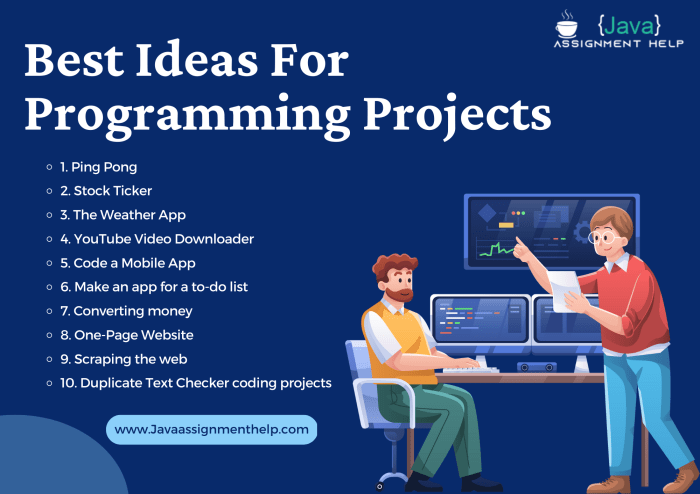
Programming project ideas can open up a world of creativity and innovation, whether you’re just starting out or you’re a seasoned pro looking for your next challenge. These projects not only enhance your coding skills but also provide practical experience that can be applied in real-world scenarios. From building a personal website to developing machine learning models, the possibilities are vast and varied.
Engaging in these projects allows learners to grasp foundational concepts while experienced developers can tackle more complex systems. The integration of interdisciplinary approaches adds another layer of excitement, combining programming with fields like social science and education. This blend can lead to the discovery of unique solutions that address contemporary challenges.
Programming Project Ideas for Beginners
Programming projects are a fantastic way for beginners to solidify their coding skills and gain practical experience. By engaging in hands-on projects, newcomers can apply theoretical knowledge and learn to tackle real-world problems. The following sections Artikel several beginner-friendly project ideas, along with a detailed explanation of how to develop a basic personal website and create a simple task manager application.
Simple Programming Projects for Skill Enhancement
Engaging in small projects can greatly assist beginners in enhancing their programming skills. Here’s a list of simple project ideas to get started:
- Calculator App: Build a basic calculator that performs arithmetic operations. This project helps in understanding logic and functions.
- To-Do List: Create a list application to add, edit, and remove tasks. This project teaches about data storage and user interface design.
- Weather App: Develop a simple weather application that shows current weather information using a public API. This enhances API integration skills.
- Personal Blog: Set up a blog platform where users can create and manage their blog posts. This project introduces concepts of web development and content management.
- Quiz App: Create an interactive quiz application that tests user knowledge on various topics. This project combines logic, UI, and data handling.
Developing a Basic Personal Website
Creating a personal website is an excellent project for beginners to showcase their skills and interests. It serves as a digital portfolio and can be developed using HTML, CSS, and JavaScript. Here’s a simple process to guide you through:
1. Planning
Start by outlining the purpose of your website, including sections like About Me, Projects, and Contact. Having a clear plan streamlines the design process.
2. Design
Sketch a layout that includes navigation menus, headings, and sections. Tools like Figma or Adobe XD can assist in creating wireframes.
3. Development
Write the HTML structure, using tags for headings, paragraphs, and links. Style the website with CSS to enhance the visual appeal. Implement responsive design for mobile compatibility.
4. Interactivity
Use JavaScript for any dynamic features, such as form validation or animations. This adds functionality and improves user experience.
5. Hosting
Choose a hosting platform like GitHub Pages or Netlify to publish your website online, making it accessible to others.
Creating a Simple Task Manager Application
A task manager application is a practical project that helps users organize their daily activities. To build this application, follow these steps:
1. Identify Essential Features
Include features like adding tasks, marking them as complete, editing tasks, and deleting them. Consider adding a priority level and deadlines for each task.
2. Choose Technologies
Use HTML for the structure, CSS for styling, and JavaScript for functionality. A framework like React can be beneficial for managing the user interface effectively.
3. Set Up the Environment
Create a project folder and set up a development environment using tools like Visual Studio Code. Initialize a Git repository to track changes.
4. Develop the User Interface
Create input fields for task details and a button to add tasks to the list. Use CSS to create a clean, user-friendly layout.
5. Implement Functionality
Write JavaScript functions to handle user input, store tasks in an array, and dynamically update the displayed task list on the webpage.
6. Testing and Iteration
Test the application for bugs and usability issues. Gather feedback and iterate on the design and functionality for improvements.These projects not only develop coding skills but also encourage creativity and problem-solving, paving the way for further advancements in programming.
Advanced Programming Projects for Experienced Developers
Embarking on advanced programming projects can significantly enhance your skills and expertise. These projects not only challenge your existing knowledge but also push you to explore new technologies and design patterns. In this section, we will delve into three sophisticated project ideas suitable for experienced developers, including the design of a complex web application, the creation of a machine learning model from scratch, and the development of a mobile application using a cross-platform framework.
Designing and Implementing a Complex Web Application with User Authentication
Creating a complex web application requires careful planning and implementation. User authentication is a critical component that ensures data security and user privacy in your application. Below are the essential steps involved in designing and implementing such a web application:
1. Define Requirements
Identify the purpose of the web application, the target audience, and the required features including user roles and permissions.
2. Choose a Technology Stack
Select appropriate technologies, such as a front-end framework (React, Angular), a back-end framework (Node.js, Django), and a database (MongoDB, PostgreSQL).
3. Set Up the Development Environment
Configure the development tools, version control (Git), and project structure.
4. Implement User Authentication
Use libraries like JWT (JSON Web Tokens) for token-based authentication or OAuth for integrating third-party services.
Create registration and login functionalities with password hashing (using bcrypt).
Develop session management to maintain user login status.
5. Design the Database Schema
Create tables or collections to store user information, roles, and other necessary data.
6. Build Out the Application Features
Develop functionalities such as profile management, dashboard, and content management as per the requirements.
7. Test and Validate
Perform thorough testing, including unit tests and integration tests, to ensure the application works as intended.
8. Deployment
Deploy the application on a cloud platform (AWS, Heroku) and ensure proper configuration of the production environment.
Creating a Machine Learning Model from Scratch
Developing a machine learning model involves several critical steps, from data collection to model validation. This process can be broken down as follows:
Data Collection
Gather relevant data from various sources such as APIs, databases, or web scraping. For instance, collecting tweets for sentiment analysis or images for classification tasks.
Data Preprocessing
Clean and prepare your data. This includes handling missing values, normalizing numerical data, and encoding categorical variables. Techniques like scaling (MinMaxScaler) or using libraries like Pandas can be beneficial.
Feature Selection
Identify the most important features that contribute to the prediction. Techniques like Recursive Feature Elimination (RFE) can help in selecting features.
Model Selection
Choose an appropriate algorithm based on the problem type (e.g., regression, classification). Libraries such as Scikit-learn provide numerous implementations.
Model Training
Split the dataset into training and testing sets. Use training data to fit the model and optimize parameters.
Model Validation
Evaluate the model’s performance using metrics like accuracy, precision, recall, or F1-score. Cross-validation techniques can provide a more reliable estimate of model performance.
Hyperparameter Tuning
Adjust model hyperparameters to improve performance using techniques like GridSearchCV.
Deployment
Deploy the model using frameworks like Flask or FastAPI to create an API for real-time predictions.
Developing a Mobile Application Using a Cross-Platform Framework
Cross-platform frameworks allow developers to write code once and deploy it on multiple platforms. Here are the key components required to develop a mobile application using such frameworks:
Framework Selection
Choose a cross-platform framework like React Native, Flutter, or Xamarin, known for their efficiency and community support.
Development Environment Setup
Install the necessary SDKs, IDEs, and libraries specific to the chosen framework.
User Interface Design
Designing a responsive UI that adapts well across different devices is crucial. Utilize UI libraries and design guidelines from the framework to ensure consistency.
State Management
Implement state management solutions like Redux or Provider (in Flutter) to handle application state effectively.
Integration of APIs
Connect the mobile app to back-end services or third-party APIs for data synchronization and functionality.
Testing Frameworks
Use testing frameworks specific to the chosen technology (like Jest for React Native) to conduct unit, integration, and UI tests.
Deployment
Prepare the application for distribution on platforms like the App Store and Google Play, ensuring compliance with their guidelines.
Embarking on advanced programming projects not only enhances your technical expertise but also prepares you for real-world challenges.
Interdisciplinary Programming Projects
In the evolving landscape of technology, interdisciplinary programming projects are gaining prominence for their ability to bridge the gap between computer science and various fields such as social sciences, education, and natural sciences. These projects not only enhance problem-solving skills but also foster collaboration among diverse disciplines, leading to innovative solutions that address real-world challenges.One significant area of development involves creating applications for data analysis in social research.
These applications play a crucial role in interpreting vast amounts of data gathered through surveys, interviews, and observations, making it easier for researchers to draw meaningful conclusions. Utilizing programming languages such as Python or R, developers can implement statistical models and visualizations to assist in understanding social phenomena.
Application for Data Analysis in Social Research
The development of applications for data analysis is paramount in social research, allowing for effective interpretation of complex datasets. Key aspects of such applications include:
- Data Collection: Integrating tools for surveys and data gathering that allow researchers to collect information efficiently.
- Statistical Analysis: Implementing algorithms that provide statistical insights, enabling researchers to test hypotheses and validate their findings.
- Visualization Tools: Creating interactive dashboards that display data in a visually engaging manner, making it easier to communicate results.
By focusing on these elements, programmers can significantly enhance the capacity of researchers to analyze social behavior and trends.
Educational Software Development in Collaboration with Empirical Sciences
Another promising interdisciplinary project is the development of educational software that integrates computer science with empirical sciences. Such collaboration fosters a curriculum that is both engaging and informative for students. When creating educational software, several key points should be considered:
- Interactive Learning Modules: Designing modules that encourage students to engage with empirical data through simulations and experiments.
- Assessment Tools: Incorporating features that allow educators to assess student progress and understanding in real-time.
- Cross-Disciplinary Content: Ensuring that the software covers topics from both computer science and empirical sciences, creating a holistic learning experience.
This integration not only enhances the educational experience but also prepares students for careers that require knowledge in multiple fields.
Comparative Approaches in Programming Solutions for Natural and Physical Sciences
Programming solutions in natural and physical sciences often require different methodologies due to the nature of the data and the problems being addressed. When approaching these challenges, the following factors should be considered:
- Data Complexity: Solutions in natural sciences may involve more complex biological data, while physical sciences often deal with quantitative measurements and physical laws.
- Modeling Techniques: Different modeling techniques are applied; for instance, machine learning might be utilized in biological studies, whereas simulations are more common in physics.
- Visualization Requirements: The visualization of data may differ; for example, depicting ecological networks in natural sciences versus physical phenomena in the form of graphs or charts in physical sciences.
Understanding these varied approaches equips developers to create tailored solutions that effectively meet the specific needs of each scientific domain.
Final Wrap-Up

In summary, exploring programming project ideas is a fulfilling journey, showcasing the versatility of coding skills across different levels and disciplines. Whether your interest lies in creating a simple application or diving deep into advanced web development, there’s something for everyone. Embrace the challenge, collaborate with others, and watch your programming capabilities flourish.
Key Questions Answered
What are some beginner-friendly programming projects?
Beginner-friendly projects include creating personal websites, simple task managers, and basic games.
How can I choose a programming project?
Consider your interests, current skill level, and what technologies you want to learn more about.
Can I collaborate with others on programming projects?
Absolutely! Collaboration can enhance learning and lead to more innovative solutions.
What technologies should I learn for web development projects?
HTML, CSS, JavaScript, and a back-end language like Python or PHP are essential for web development.
How do I validate a machine learning model?
Use techniques like cross-validation and testing on a separate dataset to ensure your model’s accuracy.


