Beginning with Sacred geometry and science, the narrative unfolds in a compelling and distinctive manner, drawing readers into a story that promises to be both engaging and uniquely memorable.
Sacred geometry, the study of geometric shapes and patterns with spiritual significance, reveals profound connections with the natural sciences. This exploration highlights how these ancient principles can explain natural phenomena and influence various fields, from art to computer science. By understanding the intersections of sacred geometry with scientific discovery, we can appreciate its relevance and implications in contemporary knowledge and practices.
Relationship between Sacred Geometry and Natural Sciences
Sacred geometry is an exploration of the patterns and forms that resonate deeply with both artistic expression and scientific inquiry. The principles behind sacred geometry often mirror natural occurrences, serving as a bridge between the metaphysical and the empirical realms of understanding. This relationship unveils how ancient wisdom can coexist with modern scientific principles, emphasizing the interconnectedness of all existence.The principles of sacred geometry are founded on the idea that certain geometric shapes and proportions are fundamental to the structure of the universe.
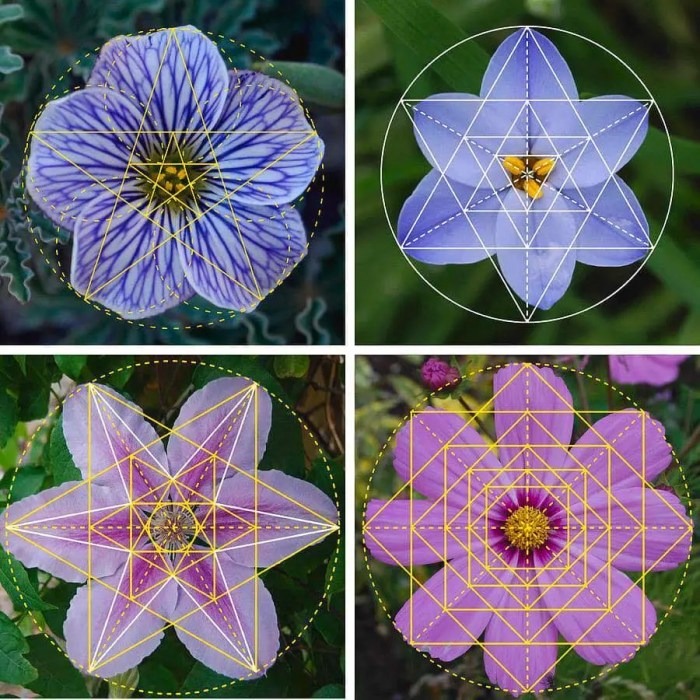
These shapes, such as circles, triangles, and the Fibonacci sequence, can be observed in natural formations, from the patterns of a nautilus shell to the arrangement of leaves on a stem. By studying these forms, scientists can gain insight into the laws governing physical phenomena. For instance, the Golden Ratio, a crucial element in sacred geometry, is often found in the proportions of living organisms, influencing everything from the growth patterns of plants to the structure of galaxies.
Influence of Sacred Geometry on Physical Laws
Understanding the profound influence of sacred geometry on physical laws enhances our appreciation of the universe. The following points highlight the intersection of sacred geometry with fundamental scientific principles:
- Mathematical Precision: Sacred geometry is grounded in precise mathematical relationships. The dimensions of the Great Pyramid of Giza, for instance, reflect the ratio of the circumference of a circle to its diameter (π), showcasing a blend of art and science.
- Wave Patterns: The study of sacred geometry reveals that sound and light waves also exhibit geometric patterns. For example, the geometric shapes created by vibrating strings or membranes lead to unique harmonic frequencies, which can be crucial in acoustics and music theory.
- Quantum Physics: Some theories in quantum mechanics draw parallels with sacred geometric forms, suggesting that the fabric of space-time may be intricately structured in a way that resembles these ancient patterns.
- Biological Structures: Numerous biological systems, such as cellular structures and DNA spirals, can be interpreted through the lens of sacred geometry, revealing an inherent order and symmetry that underpins life itself.
- Astronomical Alignments: Many ancient structures, like Stonehenge, are aligned with celestial bodies. This reflects an understanding of cosmic geometry, demonstrating how sacred geometry intersects with astronomy and the physical laws governing celestial mechanics.
Historical instances where sacred geometry has intertwined with scientific discovery further illustrate this deep connection. In the Renaissance, artists like Leonardo da Vinci utilized geometric principles not only in their artwork but also in their scientific studies, leading to advancements in anatomy and perspective. Additionally, Pythagorean teachings emphasized the importance of numerical relationships found in nature, impacting both mathematics and philosophy.The relationship between sacred geometry and natural sciences continues to inspire curiosity and exploration, revealing a landscape where ancient knowledge and contemporary understanding coexist and enhance one another.
Sacred Geometry in Social and Empirical Sciences
Sacred geometry has long been regarded as a bridge between the spiritual and the tangible, offering profound insights into the structures and patterns that govern both natural and social worlds. In social and empirical sciences, the principles of sacred geometry can illuminate complex social behaviors and structures, revealing how deeply interconnected our cultural practices and community designs are with these ancient forms.
By examining this relationship, we can better understand the frameworks that shape our societies.The application of sacred geometry in social sciences can be particularly insightful, as it allows researchers to explore the underlying patterns that influence human interactions and societal frameworks. This geometrical lens provides a unique way of conceptualizing social relationships, spaces, and structures, often leading to the identification of harmonious patterns akin to those found in nature.
Such insights can foster better communication and cooperation within communities, as well as inform the design of social programs and structures that promote well-being.
Applications of Sacred Geometry in Psychology and Sociology
The intersection of sacred geometry with psychology and sociology offers intriguing possibilities for understanding human behavior and societal dynamics. By analyzing the geometric shapes and patterns that recur in both disciplines, we can uncover the deeper meanings behind social interactions and psychological phenomena. In psychology, for instance, the use of shapes like the circle, triangle, and pentagon can symbolize various aspects of human experience.
A circle may represent unity and wholeness, while a triangle can signify balance and harmony. These shapes can be utilized in therapeutic practices, helping individuals explore their emotions and relationships through visualizations that resonate with the principles of sacred geometry. Sociologically, sacred geometry can guide the planning and organization of spaces that foster community interaction. For example, public squares designed in circular shapes can create inclusive environments that encourage social gathering and dialogue.
Similarly, the incorporation of geometric patterns in urban planning can enhance the aesthetic appeal of a neighborhood while promoting social cohesion.The following points highlight how sacred geometry can influence art, culture, and community design:
- Artistic Expression: Artists often draw inspiration from sacred geometry, using shapes and patterns to convey deeper meanings in their work. The incorporation of geometric designs in contemporary art can foster a sense of connection to ancient traditions, creating a bridge between the past and present.
- Cultural Identity: Many cultures integrate sacred geometric patterns in their traditional crafts and architecture, helping to define their collective identity. These patterns can serve as visual representations of cultural values and beliefs, reinforcing a sense of belonging among community members.
- Community Spaces: Architectural designs that reflect sacred geometry principles tend to create more harmonious and functional community spaces. Buildings and public areas that incorporate these designs can promote well-being and social interaction, ultimately contributing to healthier communities.
- Educational Tools: Integrating sacred geometry into educational contexts can enhance students’ understanding of both mathematical concepts and cultural history. By exploring the significance of geometric shapes across different cultures, learners can appreciate the universality of these ideas.
Integration of Sacred Geometry in Computer Science Education
The integration of sacred geometry into computer science education presents a unique opportunity to bridge the gap between art, mathematics, and technology. By incorporating concepts such as patterns, symmetry, and fractals into programming curricula, educators can inspire students to explore the beauty and significance of geometry beyond traditional boundaries. This approach not only enhances creativity but also deepens understanding of complex computational concepts through visual representation.In designing a curriculum that integrates sacred geometry, it’s crucial to Artikel specific learning objectives that align with both geometry and programming skills.
By doing this, students will not only learn programming languages but also appreciate how these languages can manifest geometric principles in digital forms. This integration will encourage students to think critically about the applications of sacred geometry in various technological fields, including computer graphics, data visualization, and algorithm design.
Curriculum Design for Sacred Geometry in Programming
A well-structured curriculum should combine theoretical knowledge of sacred geometry with practical programming exercises. Here are essential components to consider:
Introduction to Sacred Geometry
Begin with the historical context and fundamental concepts of sacred geometry, such as the Golden Ratio, Fibonacci sequence, and Platonic solids.
Programming Basics
Introduce students to a programming language suitable for geometric visualization, such as Python or JavaScript. Focus on libraries that support graphics, like Pygame for Python or p5.js for JavaScript.
Project-Based Learning
Assign projects that require students to implement sacred geometry principles. Examples include creating fractals, designing geometric shapes, or visualizing mathematical equations that reflect sacred geometry.
Interdisciplinary Approach
Encourage collaboration with art and design departments to create projects that blend coding with artistic expression through sacred geometry.
Assessment Methods
Evaluate students’ understanding through practical projects, presentations, and a reflection essay on how sacred geometry enhances their programming skills.
Project Development Utilizing Sacred Geometry
Creating a project that incorporates sacred geometry into algorithm design or data visualization can yield exciting results. Here’s an example project Artikel:
Fractal Generation Project
Students can create a program that generates fractals, such as the Mandelbrot set or Sierpinski triangle. This project allows them to explore recursion and iterative processes while appreciating the aesthetic appeal of fractals.
Data Visualization of Geometric Patterns
Allow students to use datasets that can be represented through geometric patterns. For instance, visualizing population growth through spirals or growth patterns can demonstrate how mathematics and coding intersect with real-world data.
Algorithm Design for Pattern Recognition
Challenge students to develop algorithms that recognize and classify geometric patterns. This can involve artificial intelligence and machine learning principles, enhancing both their programming skills and understanding of sacred geometry.
Tools and Technologies for Teaching Sacred Geometry Principles
Several tools and technologies can enhance the teaching of sacred geometry within coding. Understanding these can empower future educators to deliver effective lessons:
Processing
This flexible software sketchbook offers tools for visual arts and graphical programming, making it ideal for sacred geometry projects.
Geogebra
A dynamic mathematics software that brings geometry to life, allowing users to create constructions and models that can visually represent sacred geometric concepts.
Unity
Though primarily a game development platform, Unity can be used to create immersive environments showcasing sacred geometry, enhancing student engagement.
Blender
A powerful open-source 3D modeling tool that can be utilized to create complex geometric shapes and visualizations based on sacred geometry.By integrating these tools into the curriculum, educators can provide a hands-on learning experience that merges the beauty of sacred geometry with the logic of computer science, ultimately preparing students for innovative careers in technology and design.
Outcome Summary
In summary, the exploration of Sacred geometry and science provides valuable insights into both natural and social realms. As we delve into its applications, we discover not just a mathematical framework, but a lens through which we can interpret the universe’s beauty and complexity. This journey emphasizes the importance of integrating these concepts into various disciplines, potentially shaping future innovations and human understanding.
Question & Answer Hub
What is sacred geometry?
Sacred geometry refers to the study of geometric shapes and patterns that are believed to have spiritual significance and are often found in nature.
How does sacred geometry relate to science?
Sacred geometry relates to science by providing frameworks for understanding natural phenomena and influencing various scientific principles and laws.
Can sacred geometry be applied in modern technology?
Yes, sacred geometry can be applied in modern technology, particularly in fields like computer science, where its principles can enhance algorithm design and data visualization.
What are some historical examples of sacred geometry in science?
Historical examples include the use of sacred geometry in ancient architecture, such as the Pyramids of Giza, and its influence on notable scientists like Leonardo da Vinci.
How does sacred geometry influence art and culture?
Sacred geometry influences art and culture by providing a visual language that connects spiritual ideas to artistic expression, evident in various cultural designs and artworks.


